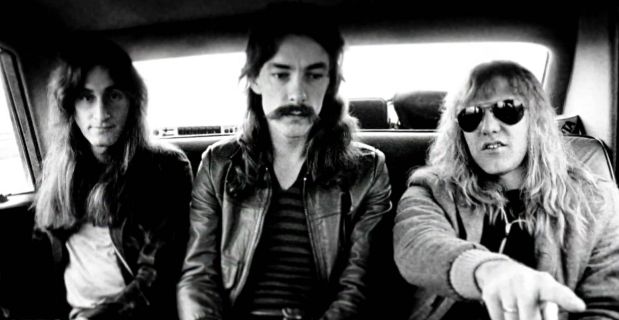
Rush is a lot of things. Awesome on their own, they are also:
My friend and I borrowing my dad’s video camera so we could make videos – me playing bass and him playing guitar, miming to “Limelight” in our jean jackets and long hair. We didn’t have video editing in those days; you just popped a VCR into the camera and hit “record.” Chris and I made three or four versions of our “Limelight” video, watched it a few times, and then used the camera to record pratfalls in the house.
Sitting in my room one evening and a friend tapping on the window to show me he had just bought Signals on cassette. He pressed the cassette up against the window like a sacred relic, like Marion in Raiders of the Lost Ark shoving the medallion in Indy’s face after he burns her bar down.
Employing the secret “guy code,” since women stayed away from Rush in droves. Someone brought a tape to school or maybe scrawled “Rush” on a notebook (tiny, never as big as Zeppelin) and you locked eyes, recognizing a member of the club. Compare it to other guy code things Gen X discovered like leaving an open urinal between us, nodding up for friends and tokens of respect, nodding down for strangers and to say hello. Or calling everyone “man.”
Becoming an amateur drummer – on real kits, on their steering wheels, on their laps, on the desk, or the chair. Even adults noticed the drums in Rush’s songs, and whether you liked Rush’s particular brand of rock-prog or not, Neil Peart was universally recognized as the best. Everyone imitated the drum break coming out of the guitar solo in “Tom Sawyer,” everyone. My dad and sister even talked about the incredible drumming on “Tom Sawyer” one summer afternoon when we were playing records together.
Playing “Xanadu” for my jazz band class as an example of cool music we liked. My band director liked the long intro of the song and made a cutting (if kind of true remark): “Bands like Rush don’t know what to do with their vocals so they just leave them out most of the time.” And we thought we were music snobs!
Understanding that you had to keep your fandom secret. Liking Rush labeled you a dork especially in the eighties when the band went through their infamous “keyboard stage.” My long-haired friend group grudgingly respected all their albums, but we usually kept our conversations and cover song attempts to songs and albums up to about Signals (which would have covered all their records from 1973-1982). After that, you were on your own.
Hoping like hell every release after Grace Under Pressure (1984) was a “return to form.” A friend drove over to my house one afternoon because he was excited to tell me that Rush’s new album Counterparts (1993) may “finally” be the one. He was half right. The yearning for Rush to resume a more traditional rock-prog approach eventually happened, of course, but various reasons made it bittersweet. We weren’t concerned with other bands like this.
My first concert alongside my sister and her skater boyfriend. We had seats on the floor, and I kept panicking because I wasn’t used to how loud these things could get. I bought a T-shirt. Rush opened with “Force Ten.” I got busted when I got home for having cigarettes in my pocket. My mom couldn’t have possibly known about the beer I drank that night, right?
Why Rush?
Why did a particular kind of kid respond to Rush so strongly? The subject came up frequently in the documentary Rush: Beyond the Lighted Stage (2010), which succeeded mightily in demonstrating the outpouring of love from musical colleagues, Gen X celebrities, and regular fans. It’s still a question that has no definitive answer, though, other than maybe they spoke our hidden language of pre-teen/teenaged American nerd-boy angst. As Rush continued to follow their own path, we recognized their dogged artistic integrity and rewarded them with continued attendance at concerts around the world that took on the flavor of religious revivals.
We recognized our nerdy selves in them. Could it also be that Rush came along at the perfect time? A lot of entertainment movers and shakers now were all formative teenagers when the group rode their most popular wave, circa the late seventies and early eighties. Not a lot of classic rock bands thrived at that time. Led Zeppelin was way past its prime during the punk era and was done by 1980. The Who? Done as well, at least in their original incarnation. Aerosmith snorted themselves to death. The Stones were, well, the Stones – aging uncomfortably and increasingly looking like perverted old farts prancing around in workout clothes (I’m thinking specifically of the video for “Start Me Up,” an MTV staple). Rush hit their peak in the late ’70s to about 1984. Boom, it might just be timing.
But it’s probably much more. Listening to Rush now, I’m keenly aware that my childhood is long gone, and the later albums don’t mean as much to me because the lure of memory associations isn’t as strong. It makes me mad that memory infects my love of music in this way. Their seventies output immediately puts me back in my small town with my cassettes, pouring over the lyrics to 2112 (1976), learning the classical guitar opening to the title track of Farewell to Kings (1977), laughing in amazement with my friends over the sheer insanity of the playing on “La Villa Strangiato” (from Hemispheres), an instrumental so iconic and challenging that it set a bar still tough to clear, the true “musician’s” cut.
We never imagined we could play something like that, and we didn’t know anyone else who could, either. Now, you can go on You Tube and find scores of talented men and women who cover the song and cover it well, and you can indulge in the amount of clips with loving comments, dripping with memories of experiences strangely similar to mine, with folks air drumming right along – Rush has turned into an entity that has united Gen X. We unabashedly celebrate them now, venerate them. Who knew a band of three Canadian nerds could have this kind of effect on an entire segment of the population?
Experience and wisdom change our perceptions of our pasts, ourselves, and the art we consume. This band went through every conceivable phase in a popular music career – and what could it teach me? It must be OK, then, to indulge in a little reminiscing if we can continue to discover things, if we can make old things new, and if we can discover things about our own growth along the way. Rush does that for me and Gen X every day.
Rush put out new fully formed, thoughtful, amazingly performed albums up until 2012! That’s inconceivable. Any other band who has been around that long is plodding around on the oldies circuit or pumping out pale reminders of long-ago glories. The absolute king of Gen X bands showed everyone how to do it the “right way” through hard work, gigging across the world, developing a sound, finding a niche, getting ridiculously rich (and kind of famous), and then took it all in elegant stride.
Their final album, Clockwork Angels, perfectly closed the circle (how often does this ever happen?) by bringing back the cheesy, sci-fi concept album with a fractured tale of an innocent teenager battling fascism in some faraway steampunk world. As loudly overproduced as it is (gone are the amazing textures of the Moving Pictures era, but the playing is still dynamic enough to transcend), the final song of their amazing career, “The Garden,” speaks simple, plaintive truths like:
“The measure of a life is a measure of love and respect
So hard to earn, so easily burned
In the fullness of time
A garden to nurture and protect”
The Beatles might be my favorite band of all time, but they belong to everyone. Rush belongs to me.